




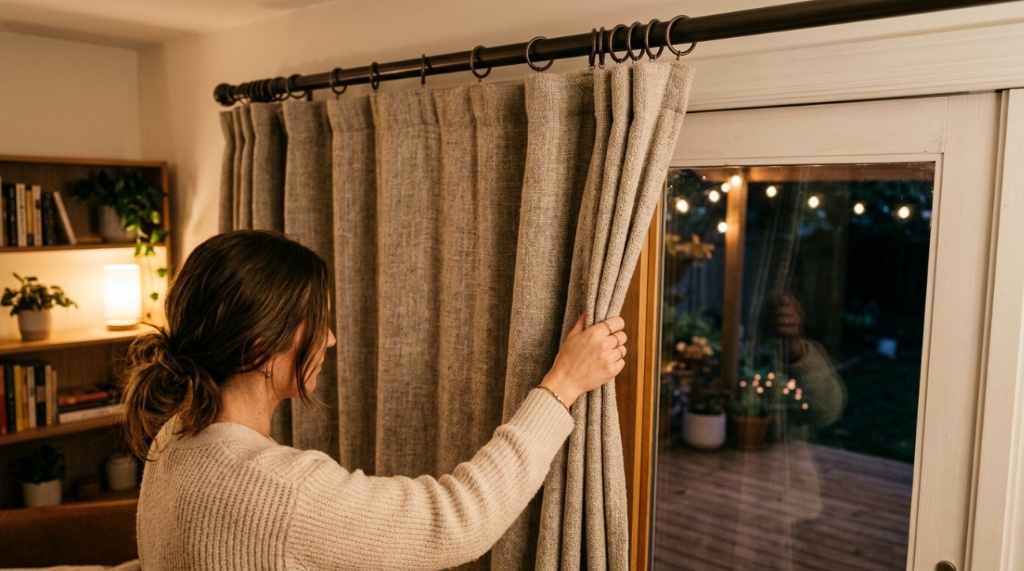
Sliding glass doors are a wonderful feature—until you realize that every time the sun goes down, your living room turns into a stage for the whole neighborhood. You need light control, privacy, and a solution that doesn’t ruin the sleek look of your glass. But finding the right option is trickier than it sounds because standard curtain rods usually don’t fit, and heavy drapes can block access to the door itself. The good news is that you have more options than you think, from ceiling tracks to tension rods and panel tracks. This guide walks you through the best ways to cover sliding glass doors, what to look for, and the mistakes to avoid so you can get privacy without sacrificing function or style.
Key Takeaways
- Ceiling-mounted tracks are the most reliable and stylish way to hang curtains on sliding glass doors, as they allow smooth movement and full access.
- Vertical blinds and panel tracks are excellent alternatives to curtains if you want a more modern, minimal look with precise light control.
- Fabric weight and opacity matter—sheer curtains alone won’t provide nighttime privacy, so consider layering or choosing blackout materials.
- Measure carefully (ceiling height, track length, and stack-back space) before purchasing; mistakes here are the most common reason curtains fail to work properly.
- Specialty retailers often offer custom widths and hardware that standard big-box stores don’t carry, making them worth checking for difficult openings.
Why Standard Curtain Rods Usually Don’t Work
Before you buy anything, it helps to understand why your standard curtain rod from a big-box store probably won’t cut it. Sliding glass doors are wide—typically 60 to 72 inches for a single door, and sometimes 96 inches or more for two-panel configurations. A standard rod can span that distance, but the real problem is the stack-back, which is the space the curtains take up when they’re fully open. If the rod extends only as wide as the door frame, the curtains will block part of the glass even when they’re pulled open. You need the rod or track to extend well beyond the door on at least one side, ideally both sides, so the fabric can clear the glass entirely. That usually means mounting hardware on the walls beside the door, which can be tricky with limited wall space. Additionally, many sliding glass doors sit flush with the ceiling or have headers that are too narrow for a traditional rod. This is why ceiling-mounted tracks and special brackets are often the better path forward.
Your Main Options for Covering Sliding Glass Doors
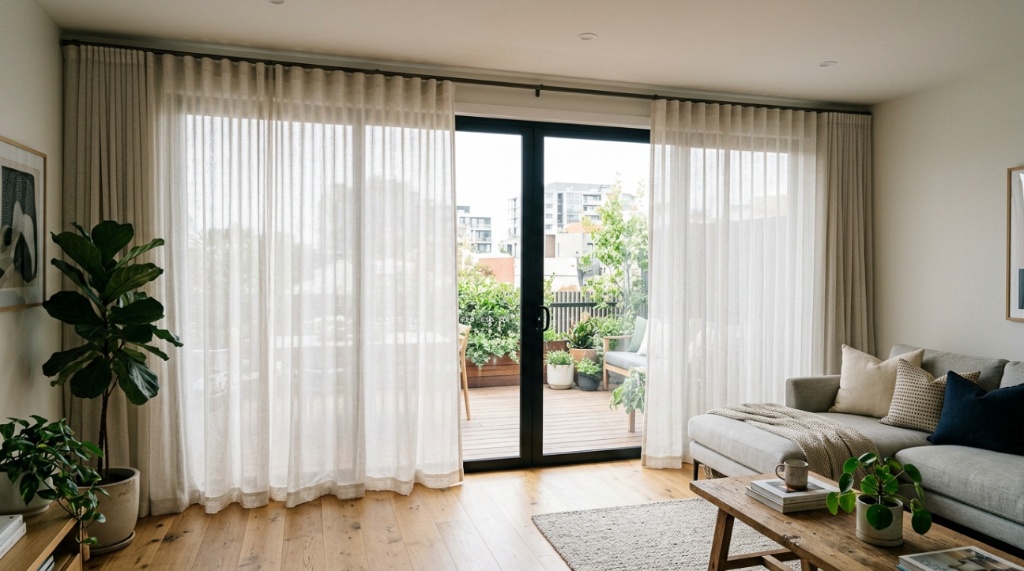
Once you understand the sizing challenge, it becomes much easier to evaluate the different styles available. Here are the most common solutions, ranked roughly by popularity and practicality.
Ceiling-Mounted Curtain Tracks
A ceiling track is generally the best solution for most homeowners. The track is mounted to the ceiling rather than the wall, which means you don’t need to worry about the header space above your door. You can make the track as long as you want, so curtains can slide completely clear of the glass. These tracks use small gliders that move smoothly, and they work with nearly any type of curtain—from light sheers to heavy blackout panels. The installation is straightforward if you have a drill and a stud finder, though you’ll need to use appropriate anchors if your ceiling is drywall. One thing to consider is that the track is visible, so choose a finish (white, black, aluminum) that blends with your ceiling or adds a subtle design accent. Ceiling tracks are also a good choice if you have high ceilings or if you want to make the room feel taller by hanging curtains from the top of the wall.
Curtain Panels on a Wall-Mounted Rod
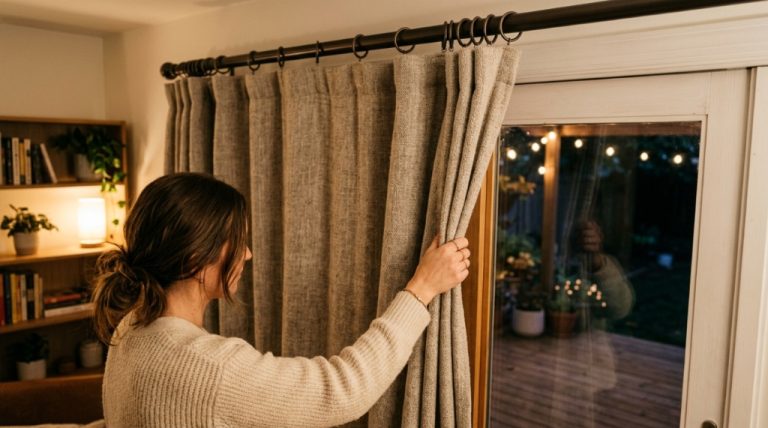
A regular curtain rod can work if you have enough wall space on either side of the door. The key is to extend the rod 10 to 12 inches beyond the door frame on each side. That way, the panel can slide fully past the glass opening. You’ll need a sturdy rod—preferably a heavy-duty or traverse rod—because wide curtains are heavy and can cause sagging in the middle. Look for rods with a center support bracket. A double rod setup is also worth considering: mount one rod for sheer curtains and another for blackout panels. This gives you daytime privacy (sheers) and nighttime privacy (blackout panels) without swapping curtains. Style-wise, this is the most flexible option because you have endless fabric choices. The downside is that it takes more wall space, and the rod can feel visually heavy if you have a small room.
Vertical Blinds
Vertical blinds were the standard for decades, and for good reason. They’re functional, inexpensive, and easy to operate. The slats tilt to control light and privacy, and the entire assembly slides to one side. They’re also easy to clean—just wipe them down with a damp cloth. However, vertical blinds have fallen out of fashion in many homes because they can look dated, and the plastic slats can get brittle and break over time. If you’re on a strict budget or you’re covering a door that’s used very frequently, vertical blinds are still a solid choice. There are also vertical blind alternatives that look more like fabric panels but operate on the same track system.
Panel Track Blinds
Panel track blinds (sometimes called panel curtains or sliding panels) are essentially wide fabric panels that slide on a track, similar to vertical blinds but with larger, more modern-looking panels. They’re excellent for sliding glass doors because they mirror the door’s motion. Each panel is typically 24 inches wide, so you can stack several panels across the track. When you open the door, you slide the panels to one side, just like the door itself. Panel tracks come in a range of fabrics, from light filtering to blackout. They have clean lines and a contemporary look that works well in modern homes. The main trade-off is that the panels don’t provide the same softness as traditional curtains, and they can only stack as far as the track allows. Also, make sure to measure carefully because panel tracks are often made to order for your specific width.
Tension Rods and Inside-Mount Options
There’s a lot of temptation to use a tension rod inside the door frame—just twist it until it grips the sides, hang a curtain, and you’re done. In most cases, this doesn’t work well. Tension rods aren’t designed to hold the weight of regular curtains, and they can slip, causing the rod and fabric to crash down. If the rod is inside the frame, the curtain will also block part of the door opening, which can be annoying. However, if your door is recessed with a deep header (rare but possible), a spring tension rod with a lightweight sheer curtain can be a temporary solution. For any permanent installation, skip tension rods and spend the extra money on proper hardware. They’re fine for a temporary dorm room or rental, but not for everyday use.
Fabric Choices: What Should You Look For?
The hardware matters, but the fabric is what actually gives you privacy. The biggest mistake people make is choosing curtains based on looks alone, without thinking about opacity and light control.
Sheer Curtains
Sheer curtains allow natural light to flood in during the day while providing some privacy from the outside. Because the fabric is loosely woven, you can see out clearly, but people outside see only vague shapes. They work well in rooms that face a backyard or a quiet street where the neighbors are far away. At night, however, sheer curtains are essentially transparent when the inside lights are on. If you’re in a dense neighborhood, sheers alone won’t make you feel comfortable.
Light-Filtering Curtains
Light-filtering curtains are the middle ground. They’re made of a tighter weave than sheers, so they cut down on glare and give you more privacy during the day. At night, they offer moderate privacy, though a strong light inside can still make silhouettes visible. These are a good option if you want some privacy but also want to maintain a bright indoor environment.
Blackout Curtains
Blackout curtains have a dense weave or a special coating that blocks nearly all light. They’re the only option that gives you total privacy at any time of day or night. They also provide insulation, keeping the room cooler in summer and warmer in winter, and they reduce noise from outside. The trade-off is that they darken the room completely, even during the day. If that’s too dark, you can layer blackout curtains with sheers: use the sheers for daytime and pull the blackout panels shut at night (or whenever you need total privacy). Blackout curtains are especially useful for bedrooms, media rooms, or any room where you need to sleep during the day.
How to Measure and Plan the Installation
Accurate measurement is the difference between a curtain setup that looks custom and one that looks like an afterthought. The good news is that you only need to measure a few things.
First, determine the width of your track or rod. The general rule of thumb is that your rod/track should be 20 to 24 inches wider than the door frame itself. This gives you 10 to 12 inches of extra space on each side. The curtains can then stack in that extra space without blocking the glass. If there’s no wall space on one side (because the door goes all the way to a corner), you’ll need to mount the rod so all the stack-back happens on the open side. In that case, plan for the rod to extend 20 to 24 inches beyond the doorframe on only one side. If you can’t do that, consider a curtain track that allows the fabric to be pulled entirely to one side.
Second, measure the height. Decide how high you want the rod or track. Mounting it higher than the top of the door frame creates an illusion of height and is a popular design trick. If you’re mounting a ceiling track, it should be positioned just in front of the header, about 3 to 4 inches from the wall. If you’re mounting a wall rod, put it 4 to 6 inches above the top of the door frame. Then measure from the rod to the floor (or to the bottom of the curtain length you want). You can have curtains that barely touch the floor, pool slightly on the floor, or hover just above it. A hover of about ½ inch is the most common and easiest to clean.
Third, think about hardware support. Wide tracks and heavy blackout curtains need extra support. For ceiling tracks, use a mounting bracket every 24 to 30 inches. For wall rods, look for rods with a center support bracket or three brackets total. If you’re installing into drywall without a stud, use toggle bolts or heavy-duty drywall anchors, not simple screws. Curtains that fall because of bad anchors are one of the most common DIY failures.
Hiring a Professional vs. DIY
Should you install the curtains yourself or pay someone? It depends on your situation. If you’re reasonably handy and you have a stud finder, a drill, and a level, you can install a ceiling track or a wall rod in about an hour. It’s a straightforward project as long as the ceiling and wall are in good shape. If your home has metal studs, a concrete ceiling, or if your door is in a location that’s hard to access (like a stairwell landing), hiring a professional installer is worth the money. They’ll have the right anchors and tools, and they’ll know how to handle tricky mounting points without causing damage. Many custom curtain companies and some home decor stores offer installation services for a flat fee. If you’re ordering custom-sized curtains, it’s often worth asking about installation as a bundle.
Where to Buy Privacy Curtains for Sliding Glass Doors
You have several options for buying, and the best one depends on your budget and whether you need custom sizes. Big-box home improvement stores carry standard-size vertical blinds, panel tracks, and curtain rods, but their selection of fabric panels for wide openings is limited. Online marketplaces have a huge range of options, including ready-made blackout panels that you can use with a ceiling track. The downside is that you can’t see the fabric in person, so you’re taking a chance on color and texture. For a truly custom look—especially if your door is an unusual size or you want a specific fabric—specialty retailers are the way to go. They can make curtains to your exact measurements, including extra-wide panels. Many specialty curtain retailers also have better hardware options and can advise you on the best mounting approach for your situation. If you’re looking for a curated selection of quality privacy curtains sliding glass doors, that type of specialty review can help you narrow down choices that actually fit and function well,
To complement your interior sliding glass fixtures, learn how wood screen doors blend with rustic home design to create a seamless indoor-outdoor transition.
Common Mistakes to Avoid
There are a few errors that pop up repeatedly when people tackle this project. Avoiding these will save you time, money, and frustration. First, don’t buy curtains that are too narrow. If you buy a single panel that’s 50 inches wide for a 60-inch door, it won’t look right, and you’ll barely be able to close it. Always get panels that are wider than your door. Second, don’t forget the stack-back. Even if you buy a curtain that fits the width of the door perfectly when it’s closed, it will block part of the view when open if the rod isn’t long enough. Third, don’t underestimate the weight of fabric. A floor-length blackout curtain is heavy—heavier than you think—so cheap plastic rings and flimsy rods will fail. Use metal rings and a sturdy rod. Fourth, don’t ignore motorization. If your door is behind a sofa or a hard-to-reach area, a motorized track can be a game changer. It’s not a luxury add-on; it’s a practical solution for daily use. Many smart-home systems integrate with motorized blinds and curtains, letting you control them with a voice assistant or an app.
Frequently Asked Questions
Can I use regular curtains on a sliding glass door?
Yes, you can use regular curtains as long as you have the right rod and mounting location. The rod must be installed above the door frame and extended well beyond the door on at least one side so the curtains can clear the glass when open.
What’s the difference between a ceiling track and a wall-mounted rod?
A ceiling track mounts to the ceiling and uses gliders to move curtains. A wall-mounted rod mounts to the wall above the door frame. Ceiling tracks typically support heavier curtains and allow curtains to slide fully clear of the glass, while wall rods depend on having enough wall space beside the door.
Are sheer curtains enough for privacy?
Sheer curtains provide privacy only during the day when the inside light is lower than the outside light. At night, when the lights are on, people outside can see through them. For total privacy at night, you need light-filtering or blackout curtains.
How much wall space do I need on each side of the door?
Ideally, you want 10 to 12 inches of free wall space on each side of the door frame. This allows the curtain to fully stack clear of the glass. If you only have space on one side, all the curtains must stack on that side, which means your rod needs to extend 20 to 24 inches beyond the door frame on only that side.
Do panel track blinds work better than curtains?
Panel track blinds are a good alternative if you prefer a modern look and want easy operation. They slide smoothly to the side and come in light-filtering or blackout fabrics. However, they don’t have the soft, layered look of traditional curtains, and the panels may not stack back as narrowly as a curtain panel can.
Should I hire a professional for installation?
If you’re comfortable using a drill and have the right tools, you can install a ceiling track or wall rod yourself. Hiring a professional is recommended if you have metal studs, a concrete ceiling, or if you’re mounting heavy blackout curtains that need precise support.
Conclusion
Getting privacy on your sliding glass doors is entirely achievable with the right approach. Start by measuring your space carefully and deciding how much stack-back space you have. Then choose between a ceiling track or a wall-mounted rod based on your wall space and preferred style. Pick fabrics based on how much privacy and light control you actually need at different times of day—not just on how they look in the store. If you’re unsure, layer sheers with blackout panels so you have flexibility. And if you want a custom fit or have an awkward opening, don’t hesitate to use a specialty retailer that can make curtains to your exact dimensions. With thoughtful planning, you’ll have privacy, light control, and a room that looks polished every time the sun goes down.






+ There are no comments
Add yours