





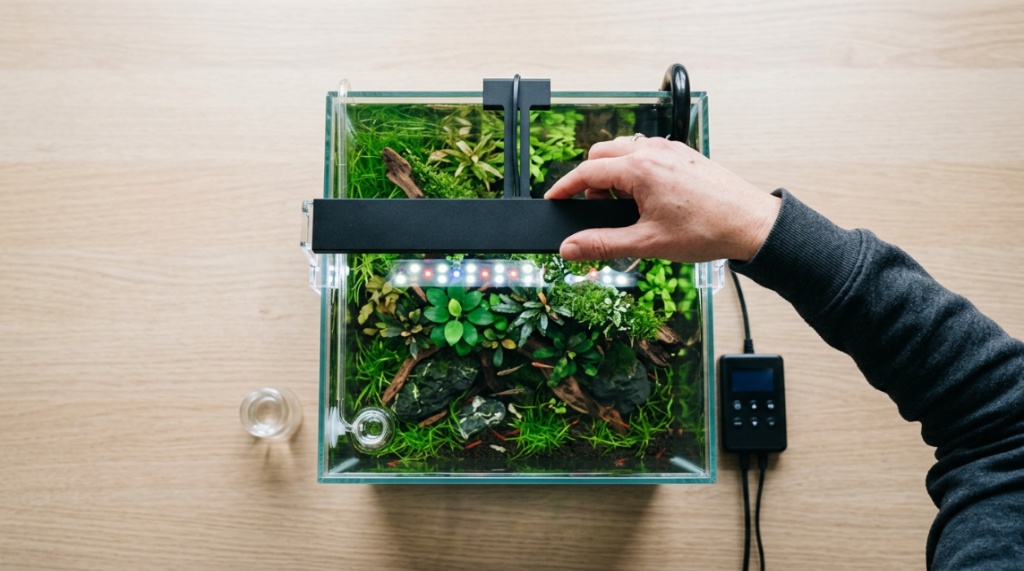
You set up your planted aquarium with high hopes. You selected the perfect substrate, added hardscape, and planted lush aquatic plants. But after a few weeks, your plants are turning yellow, melting away, or simply refusing to grow. The culprit is almost always poor lighting. Choosing the right planted aquarium lights LED aquarium light isn’t just about making your tank look pretty—it’s about providing the specific spectrum and intensity your plants need for photosynthesis. Without the correct light, even the best fertilizers and CO2 systems will fail. This guide walks you through every technical factor you need to know so you can stop guessing and start growing a thriving underwater garden.
What Makes an LED Light Suitable for a Planted Tank?
An LED light is suitable for a planted tank when it emits the correct photosynthetic active radiation (PAR) at the right color spectrum (typically 6500K–7500K) and has sufficient intensity to reach plants at the bottom of your tank without promoting excessive algae. Not all LEDs are created equal. Many aquarium lights are designed purely for aesthetic viewing—they make fish look great but starve plants of the energy they need.
Three critical features define a planted-tank-ready LED:
- Spectrum quality: Look for full-spectrum LEDs with peaks in the red (660nm) and blue (450nm) ranges, which drive chlorophyll production.
- Sufficient PAR values: PAR (Photosynthetic Active Radiation) measures usable light for plants. Low-light plants need 15–25 PAR, medium-light plants need 25–50 PAR, and high-light plants (carpets) require 50+ PAR.
- Dimming and adjustability: Controllable intensity lets you acclimate new plants and prevent algae outbreaks.
Why Is Light Spectrum Critical for Plant Growth?
Light spectrum determines whether your plants perform photosynthesis efficiently or simply survive. Plants primarily use red and blue wavelengths for growth. Red light (620–700nm) drives stem elongation and flowering, while blue light (400–500nm) promotes compact, leafy growth. Green light (500–600nm) is less absorbed by chlorophyll but penetrates deeper into the water column, helping lower leaves.
A quality planted aquarium lights LED aquarium light will provide a balanced full spectrum that mimics natural sunlight, typically around 6500K color temperature. Avoid lights that are overly “cool white” (10,000K+), which are better for saltwater reefs, or “warm white” (3000K), which encourages algae. For most planted tanks, a 6500K–7500K spectrum with strong red and blue diodes is the sweet spot.
How to Verify Spectrum on a Product Page
Look for a spectral distribution graph. It should show distinct peaks in the blue (450nm) and red (660nm) ranges. If the manufacturer only provides a color temperature value without a graph, you are taking a risk.
How Many Watts or Lumens Do You Really Need?
You need roughly 30–50 lumens per liter (or 0.5–1 watt per liter for older LED technology) for low-to-medium light planted tanks. For high-tech tanks with CO2 injection, aim for 50–80 lumens per liter. However, wattage and lumens are misleading metrics for plants. Always prioritize PAR values over wattage or lumens.
| Plant Type | Par Level (µmol/m²/s) | Lumens Per Liter (Approx.) |
|---|---|---|
| Low-light (Anubias, Java Fern, Moss) | 15–25 | 20–30 |
| Medium-light (Crypts, Swords, Vallisneria) | 25–50 | 30–50 |
| High-light (Carpets, Red Plants, HC Cuba) | 50–80+ | 50–80 |
Tip: A 60cm (24-inch) tank with medium light needs about 25–35 actual LED watts from a quality fixture. If you buy cheap LEDs labeled “60W” but they actually consume only 15W from the wall, your plants will suffer.
Which Form Factor Fits Your Aquarium Best?
The form factor of your LED light matters for light distribution and aesthetics. The three most common form factors for planted aquarium lights LED aquarium light setups are:
- Narrow strip lights: Best for tanks up to 60cm wide. They sit on the rim or hang above and provide focused light. Affordable but may create dark spots on larger tanks.
- Wide panel lights: Cover the entire tank width. Excellent for even light distribution and high PAR. More expensive but ideal for demanding plant layouts.
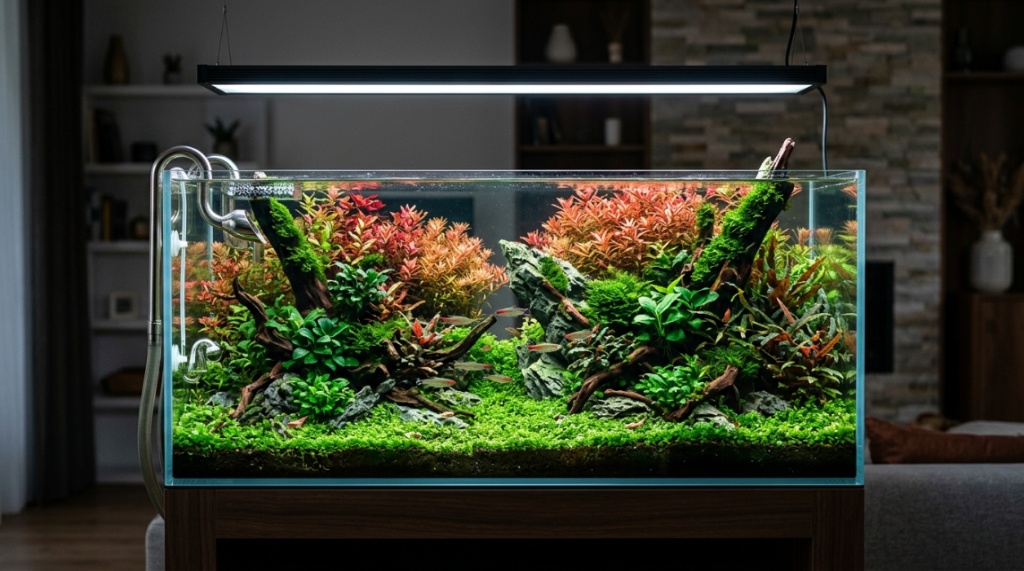
- Hanging pendant fixtures: Used for rimless, open-top aquariums. Offer the best adjustability for intensity and height. Look sleek but require a ceiling mount or bracket.
For tanks over 60cm deep, consider two fixtures side-by-side or a single high-coverage panel to avoid shadows in the middle.
Can You Use a Cheap Aquarium Light for Live Plants?
You can use a cheap light for undemanding plants like Java Fern, Anubias, or Hornwort, but you will not grow red plants, carpeting plants, or anything requiring high intensity. Cheap lights often lack the correct red spectrum, have low PAR values, and degrade quickly. You will likely face poor growth and algae problems due to weak or unbalanced light.
If you are on a tight budget, look for lights with at least 0.5 watts per liter and a stated color temperature of 6500K. Avoid “multi-color” cheap LEDs that use blue and red bulbs separately without full-spectrum blending—they produce a garish pink light that stresses fish and makes your tank look unnatural.
How Does Tank Depth Affect Your Lighting Choice?
Water absorbs light exponentially. For every 10cm of water depth, you lose roughly 40% of light intensity. A 45cm deep tank needs a much more powerful light than a 30cm shallow tank. For shallow tanks (up to 35cm), a standard LED strip with 20–30 PAR at the substrate is fine. For deeper tanks (40–60cm), you need high-output fixtures with strong lenses or multiple light bars.
When evaluating specs, look for PAR data measured at the substrate level. Many manufacturers only provide PAR at the water surface, which is meaningless for plants growing at the bottom.
Quick Depth Guide
- Shallow (20–30cm): 15–30 watts LED, low to medium light plants.
- Medium (35–45cm): 30–50 watts LED, medium to high light plants, CO2 recommended.
- Deep (50–60cm+): 50–80+ watts LED, high-output fixtures, CO2 essential.
When Should You Choose a Light with a Timer and Dimmer?
You should choose a light with a built-in timer and dimmer if you want consistent photoperiods, gradual sunrise/sunset effects, and algae prevention. A timer ensures your plants get exactly 6–10 hours of light daily—never more, never less. A dimmer allows you to start with low intensity (30–50%) for the first two weeks when you introduce new plants, gradually ramping up to full power to avoid shocking them and triggering algae blooms.
Lights without timers or dimmers require you to manually plug and unplug them, which leads to inconsistent schedules. Algae thrives on irregular lighting. Spend the extra money on programmability—it is the single best investment you can make for long-term stability.
How to Choose the Right Light for Low, Medium, and High Tech Setups
Your choice of planted aquarium lights LED aquarium light depends entirely on your equipment level and plant ambitions:
- Low-tech (no CO2, low light): You need at least 15–25 PAR at the substrate. Any decent full-spectrum LED from a reputable brand will work. Stick to undemanding plants. No dimmer needed, but a timer helps.
- Medium-tech (low CO2 or liquid carbon, moderate light): Aim for 25–50 PAR. A dimmable LED with 6500K spectrum is ideal. You can grow stem plants and some red plants.
- High-tech (pressurized CO2, high light): You need 50–80+ PAR at the substrate. Get a powerful, fully programmable LED fixture with high-output diodes. This is the only way to grow dense carpets and intensely colored red plants like AR mini or Rotala wallichii.
Remember: High light without CO2 leads to algae and plant starvation. Always match light intensity to your CO2 and fertilization regimen.
Which LED Brands Are Trusted by Planted Aquarium Keepers?
While many brands exist, the hobby has gravitated toward a few reliable names known for accurate PAR data, long diode life (50,000+ hours), and consistent spectrum. If you are looking for a balance between quality and value, we have curated a selection of the best planted aquarium lights LED aquarium light options that deliver real performance without breaking your budget. Trusted names typically offer at least 2-year warranties, replaceable parts, and published PAR maps.
When evaluating any brand, check for independent PAR tests on YouTube or forums. Beware of companies that refuse to publish PAR data at different water depths—this is a red flag.
What PAR Level Should You Aim For at the Substrate?
You should aim for the following PAR levels at the substrate depending on your plant goals:
- 15–25 PAR: Anubias, Java Fern, Moss, Cryptocoryne (low light).
- 25–40 PAR: Swords, Vallisneria, Hygrophila, Bacopa (medium light).
- 40–60 PAR: Stems like Rotala, Ludwigia, Pearlweed (medium-high light).
- 60–80+ PAR: Carpet plants (HC Cuba, Monte Carlo, Glossostigma), red plants (AR mini, Rotala macrandra).
Use a PAR meter (or borrow one) to measure at the substrate. If you cannot afford a meter, use an online PAR estimation tool based on your light model and tank dimensions. Many aquarists also use the “shrimp test”: if low-growing moss and plants thrive without algae, your PAR is likely in the right zone.
How to Position Your LED Light for Even Coverage
Position your LED light so it is centered front-to-back and side-to-side over your aquarium. For strip lights, ensure the light bar is no more than 15–20cm above the water surface (for standard tanks). Raising the light reduces PAR by the inverse square law, so every 5cm increase dramatically drops intensity. For deep tanks, keep the light 10–15cm above the surface to maximize penetration.
If you notice shadows in the corners or along the back edges, your light is too narrow or too far away. Consider adding a second light bar or opting for a wider panel. For rimless tanks, pendant lights should hang 15–20cm above the rim for optimal spread.
Avoiding Hot Spots
If your light is too concentrated in the center, your foreground plants near the glass will stretch toward the middle. Use diffusers or angle the light slightly downward to distribute the beam evenly.
Frequently Asked Questions
Can I use a regular household LED bulb for my planted aquarium?
You can use a standard 6500K household LED bulb for a very small, shallow tank (under 30 liters) with only low-light plants like Java moss or Anubias. However, household bulbs lack the correct spectrum for robust growth and may overheat in a typical desk lamp setup. Dedicated aquarium LEDs are much safer and more effective.
How long should I run my planted aquarium LED lights each day?
Run your lights for 6–10 hours daily. Start with 6–7 hours for the first few weeks to prevent algae, then increase by 30 minutes per week up to 8–10 hours. A consistent photoperiod is more important than total hours. Use a timer to maintain a strict schedule.
Do I need CO2 if I have a strong LED light?
Yes, if you run high-light LEDs (PAR 50+), you absolutely need pressurized CO2. Without it, plants cannot utilize the extra light, and algae will dominate. For medium light (25–40 PAR), liquid carbon supplements may suffice, but pressurized CO2 is always better for stability.
How often should I replace my planted aquarium LED light?
Quality LED lights last 30,000–50,000 hours, which is roughly 5–10 years of normal use. However, the diodes can lose intensity over time. If you notice your plants growing poorly despite unchanged settings after 3–4 years, it may be time to replace the fixture. Some lights have replaceable diodes or modules.
Can I use a blue moonlight on my planted tank overnight?
You can use a dim moonlight for a short period (1–2 hours) to observe nocturnal activity, but continuous blue light overnight can stress fish and encourage cyanobacteria (blue-green algae). Most planted tanks do not need moonlight. Plants need a dark period of 6–8 hours to rest and complete metabolic processes.
Is a programmable sunrise/sunset feature worth the extra cost?
Yes, for most aquarists. Gradual dawn and dusk reduce stress on fish, prevent sudden fright, and help acclimate plants to light changes. It also makes viewing more natural. If you have a high-tech tank, programming a ramp-up period (30–60 minutes) helps prevent algae spikes caused by sudden bright light hitting a tank full of accumulated CO2 overnight.
What is the best budget LED light for a 20-gallon tall planted tank?
For a 20-gallon tall tank (roughly 60cm deep), choose a light with at least 30–40 actual watts and a PAR of 30–40 at the substrate. Look for lights with adjustable arms or legs that can be raised or lowered. Avoid super-thin strips—they often lack the power for tall tanks.
To naturally weave in your existing article, Maintain an Aquarium Air Pump for Long-Term Use, you can place this internal link in a section discussing equipment synergy or water movement (since surface agitation from an air pump interacts with how light penetrates the water).
Conclusion
Choosing the right planted aquarium LED light comes down to understanding three things: the correct spectrum (6500K with strong red/blue peaks), sufficient PAR at the substrate (matched to your plant and CO2 setup), and a timer or dimmer for consistency. Avoid relying on wattage alone—PAR is the only metric that matters for plant growth. Start with low light if you are new, and upgrade only when your skills and equipment permit. A quality LED is an investment that will support a lush, algae-free planted tank for years. Take the time to measure your tank depth, list the plants you want to grow, and select a light with verifiable PAR data. Your plants will thank you with vibrant, healthy growth.






+ There are no comments
Add yours