



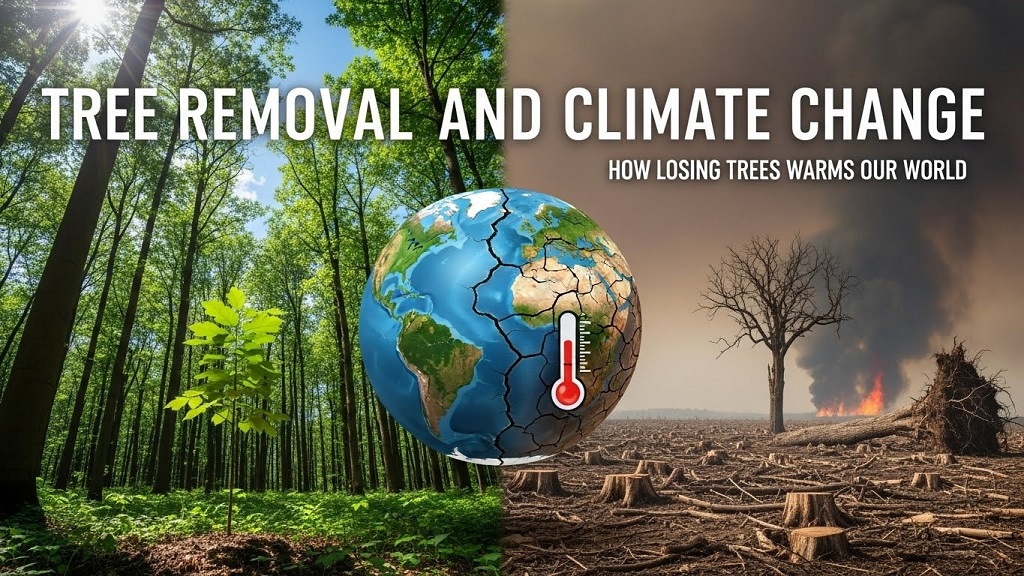
Tree removal and climate change are directly linked: when trees are cut down, the planet loses one of its most effective natural tools for cooling the atmosphere, while the carbon stored in wood often ends up back in the air as heat‑trapping gas. Every removed tree may seem small, but at scale, cumulative losses of forests are a major driver of global warming through increased greenhouse gas concentrations and disrupted local climates.
Why Tree Removal Warms Our World
Trees act as living carbon banks, pulling carbon dioxide from the air through photosynthesis and storing it in trunks, branches, roots, and soil. When large numbers of trees are removed, the world loses this ongoing “withdrawal” of carbon from the atmosphere, so more CO₂ stays in the air and traps heat. At the same time, clearing trees exposes bare ground, reduces shade, and changes how sunlight, heat, and moisture move through an area, often making local climates hotter and drier.
Even necessary or small‑scale tree removal, such as clearing for safety near power lines or removing diseased trees, contributes to the bigger climate picture if losses are not balanced with replanting. The problem becomes especially serious when tree removal scales up to deforestation, where entire landscapes lose their tree cover and their ability to regulate climate. Understanding this connection helps homeowners, communities, and policymakers make smarter choices about when and how trees are removed—and how quickly they are replaced.
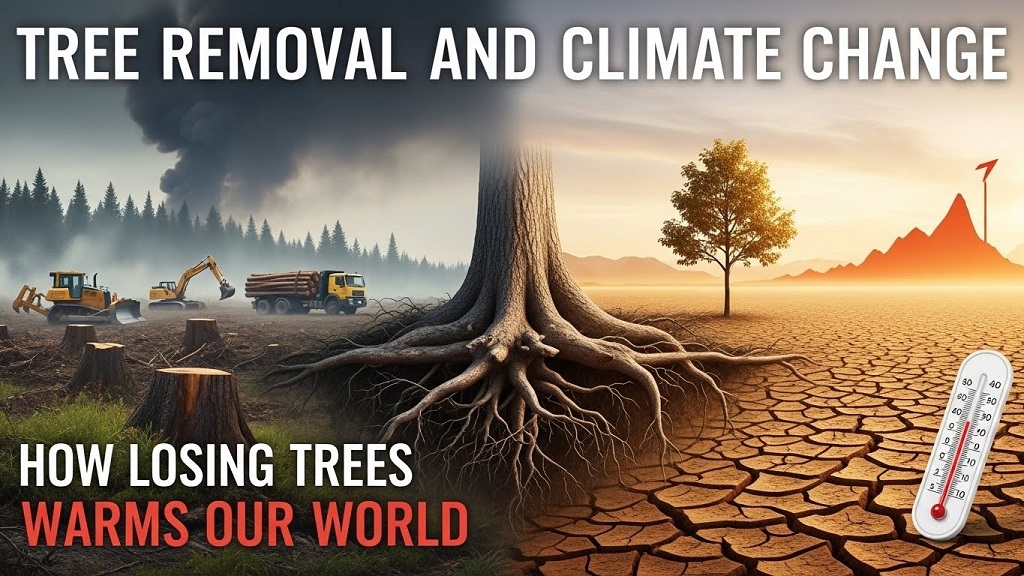
Trees and carbon storage
The phrase “trees and carbon storage” captures one of the most important climate services forests provide. Trees absorb CO₂, convert it into organic matter, and store that carbon in wood and roots for years to centuries, depending on species and forest management. This stored carbon is effectively locked away and kept out of the atmosphere as long as the tree and its surrounding ecosystem remain intact.
Tree roots and fallen leaves also add carbon to the soil, turning forest floors into massive underground carbon reservoirs. Healthy, mature forests accumulate carbon over time, meaning every additional decade of growth increases the total carbon stored. When these systems are left undisturbed, they act as long‑term carbon sinks, helping offset part of the emissions from human activities such as transportation and industry.
Carbon emissions from deforestation
“Carbon emissions from deforestation” describes what happens when those living carbon banks are suddenly liquidated. When trees are cut and burned or left to rot, the carbon stored in biomass is released back into the air as CO₂ and other gases. This release can happen rapidly (through fire) or more slowly (through decomposition), but the climate impact is the same: more greenhouse gases accumulate in the atmosphere.
Large‑scale deforestation magnifies this effect by combining one‑time emissions from removed trees with the permanent loss of a functioning carbon sink. Not only is stored carbon released, but the ongoing future uptake of CO₂ by those trees disappears as well. When deforested land is converted to uses such as intensive agriculture or urban development, it often stores far less carbon than the forest it replaced, locking in a higher baseline of emissions over the long term.
How losing trees changes local climate
Tree removal does not only affect global climate; it also reshapes local temperature, moisture, and weather patterns. Tree canopies provide shade that keeps ground and nearby buildings cooler, reduce heat absorption by asphalt and concrete, and moderate temperature extremes. When those trees are removed, surfaces heat up more quickly during the day and retain heat longer at night, intensifying the “heat island” effect in cities and suburbs.
Trees also regulate the water cycle by pulling moisture from soil and releasing it into the air through transpiration. This process cools the surrounding air and supports cloud formation and rainfall patterns. Removing trees reduces this natural cooling and can lead to drier local conditions, degraded soil, and greater vulnerability to droughts and heat waves. Over time, landscapes stripped of trees often experience more extreme temperature swings and more frequent environmental stress.
Tree removal, biodiversity, and resilience
Forests are not just collections of individual trees; they are complex ecosystems full of plants, animals, fungi, and microorganisms that contribute to climate resilience. When trees are removed, habitats shrink or disappear, leading to declines in species that depend on forest cover. Losing biodiversity can undermine ecosystem stability, making forests less able to withstand disturbances such as storms, pests, and disease outbreaks.
Climate resilience is closely tied to the health of these ecosystems. Diverse, intact forests are better at absorbing shocks like severe weather and recovering afterward, which helps maintain carbon storage and local climate regulation over time. When tree removal pushes ecosystems past certain thresholds, the system may shift into a new, less carbon‑rich state, making it much harder to restore previous levels of climate protection.
Responsible tree removal in a warming world
Not all tree removal is avoidable; sometimes it is necessary for safety, infrastructure, or ecological health (for example, removing invasive species or trees that pose a fall risk). The key, in a climate‑conscious world, is to treat removal as a last resort and to offset it with smart planning. Before cutting, it is wise to ask whether pruning, structural supports, or alternative designs could solve the problem while preserving the tree.
When removal must happen, responsible management means tracking how many trees are lost, the species involved, and the total approximate carbon storage being removed. It also means planning replanting in advance—choosing native, climate‑appropriate species, diversifying plantings to avoid future disease outbreaks, and protecting soil so it can continue to store carbon. This approach limits the net carbon emissions from local projects and keeps landscapes cooler and more resilient.
Reforestation after removal
“Reforestation after removal” is one of the most effective ways to restore climate benefits once trees have been cut. Reforestation involves replanting trees or encouraging natural regrowth in areas where removal has occurred, with the goal of rebuilding forest structure, biodiversity, and carbon storage over time. The sooner reforestation starts, the faster the landscape can begin absorbing CO₂ again and stabilizing local temperatures.
Successful reforestation after removal requires more than simply planting any available tree. It involves selecting species suited to the local climate and soil, ensuring a mix of ages and types to mimic natural forests, and caring for young trees until they are established. Over years and decades, these new plantings can grow into thriving forests that once again serve as powerful allies in the fight against climate change, reversing some of the warming effects of earlier removals.
Practical steps for homeowners and communities
Homeowners, businesses, and local governments can all play a role in reducing the climate impact of tree removal. For individuals, this may start with conducting a tree inventory on their property, identifying which trees are healthy and valuable for shade and carbon storage, and prioritizing preservation wherever possible. When removal is unavoidable, committing to plant at least one, and ideally several, new trees for every tree cut can help maintain or increase overall tree cover.
Communities can adopt tree protection ordinances, invest in urban forestry programs, and partner with local organizations for neighborhood planting events. Schools and community groups can educate residents about the link between tree removal and climate change, empowering people to make informed decisions about their own landscapes. Over time, coordinated local actions can add up to significant gains in canopy cover, carbon storage, and climate resilience.
Balancing development, safety, and climate goals
Modern cities and growing suburbs constantly face trade‑offs between development, safety, and environmental protection. Construction projects, road expansions, and utility work often involve tree removal. To align these activities with climate goals, planning processes can include tree‑preservation assessments, carbon‑impact estimates, and clear requirements for reforestation after removal.
Developers and planners can design around existing trees where feasible, integrate green corridors and parks into new projects, and use green infrastructure such as street trees, green roofs, and rain gardens to offset lost canopy. By treating trees as critical infrastructure rather than optional aesthetics, communities can grow and modernize while still protecting the climate benefits that forests and urban trees provide.
FAQs about tree removal and climate change
Does removing a single tree really affect climate?
One tree by itself has a small impact, but many individual removals across neighborhoods, cities, and regions add up to substantial losses in carbon storage and shade, which together contribute to warming trends.
Are some trees better for carbon storage than others?
Yes. Fast‑growing, long‑lived species that reach large sizes tend to store more carbon over their lifetimes, but native species that are well adapted to local conditions often perform best overall because they are more likely to thrive.
What is the difference between deforestation and routine tree removal?
Routine removal usually refers to small‑scale actions, such as cutting a few trees on private property for safety or maintenance, while deforestation typically means large‑scale conversion of forest to other land uses, with much larger climate consequences.
How soon should reforestation happen after tree removal?
Ideally, replanting or encouraging natural regrowth should begin as soon as possible after removal to limit the time the site spends without tree cover and to restart carbon uptake quickly.
Can planting trees elsewhere offset carbon emissions from deforestation?
Planting trees in new locations helps, but it is not a perfect replacement for the complex, mature forests that were lost. Protecting existing forests remains one of the most effective climate strategies, and reforestation is most powerful when combined with strong conservation.
Call to action: plant, protect, and plan
Tree removal and climate change are inseparable issues, but every person and community has the power to shift the balance toward a cooler, more stable future. Start by protecting the healthy trees around you, choosing removal only when there is no safer alternative, and committing to reforestation after removal to restore lost carbon storage and shade. Then, get involved locally: support tree‑friendly policies, volunteer for planting projects, and encourage others to see trees not just as scenery, but as vital climate protectors.
Related Topics: The Sims 4 Legacy Challenge: A Comprehensive Guide to Building Your Multi-Generational Story
Related Topics: What to Put in Front of Window in Living Room: The Ultimate Guide to Styling Your Space






+ There are no comments
Add yours